If you’re a top author with a major publisher, you can count on your publisher to produce slick and effective promotional materials for you and your books. The rest of us can benefit from such materials too . . . but we’re pretty much on our own to produce them.
Luckily, that has become easier over the years. By the time I started in children’s writing, reasonably professional materials could be produced cheaply and conveniently at home on a laser printer, instead of paying a commercial printer for hundreds of copies—which always seemed to include at least one typo.
Later, as the Web became popular, I could post the materials online, either as viewable pages or as downloads, and not bother with printing at all. And though creating the Web site was itself a huge chore, that part of the job has now grown easier for most authors, as sites like Facebook and Blogger have stepped up to do much of the heavy lifting.
What has not changed, though, is the kinds of materials an author will benefit from providing. Here are some of the “promo pages” you might create—whether online or on paper—along with links to my own as examples.
Author intro. This general page contains all the most important information about you and the kind of books you write. It projects the image you wish to convey. Include any significant awards and general testimonials.
Book info. You’ll need this as a quick way to convey all essential information about each of your books—and possibly to record them for yourself! A page can feature one book or many. Include graphics from the book covers or interior art, comments from reviewers, and possibly excerpts.
Appearance info. For author visits and other appearances, detailed information is usually conveyed more quickly and easily in prepared documents than by phone or in email. In the days I still made such appearances, my own assortment of documents included “School Visits,” “Library Visits,” “Conference Appearances,” “Talks and Workshops,” “Book Sales and Ordering,” and “Fees and Expenses.”
Author profile. This is a more in‑depth look than is provided in the author intro. Blogs, Web sites, or journals might want to feature this, and teachers can use it to help prepare students for your school visit. Include personal history, a description of your writing process, and anything else that will make you come alive in the mind of the reader.
Instructional aids. Teachers may be more likely to use your book if there are classroom activities to go with it. Some authors with strong educational backgrounds prepare detailed lesson plans. For most of my own picture books, I’ve provided a free reader’s theater script for easy classroom dramatization.
Autographed bookmarks. Create a sheet that has several signed bookmarks on it for giveaways. You can ask schools you visit to make copies ahead of time and cut them into individual bookmarks. This way, even students who don’t buy books can have something to take home.
Photo. Produce a high‑quality, high-resolution color photo of yourself that can be downloaded or attached to email. To allow for printing, make it at least 1200 pixels wide—4 inches at 300 pixels per inch, or an equivalent. A JPEG is OK, as long as it has been saved with a quality setting of “High” or better. (If the setting is for compression rather than quality, it should be “Low” or less!)
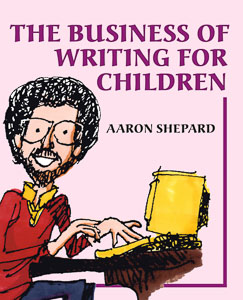
Others. No doubt you’ll think of other promo pages suited to you and your work. Among my favorites is a “portrait poster” with a cartoon sketch of me by the illustrator of two of my books.
A final tip: Many promo pages must be kept current with up-to-date information, and this can take a fair amount of your time. So be selective in creating your pages. Promotion is worthwhile, but not if it keeps you from writing!